

Port Charlotte’s School Zone Cameras: Are They Already in Trouble? |
Is Port Charlotte Enforcing a Law That’s About to Be Challenged? |
It didn’t happen in Port Charlotte.It didn’t even happen in our county.
But a single dismissed red-light camera ticket in Broward County may have quietly set something much bigger in motion—something that could eventually reach right into the way traffic laws are enforced here at home.
A judge looked at a red-light camera citation and asked a simple question: How can you punish someone… without proving they were the one driving?
That question—and the answer that followed—may end up mattering far more than most people realize.The case itself was straightforward. A driver challenged a red-light camera ticket. The court reviewed how the law works—how a camera captures a violation, identifies a vehicle, and then sends a citation to the registered owner.
Not the driver. The owner.And that’s where things began to unravel.
According to reporting on the case, a Broward judge ruled that Florida’s red-light camera framework violated due process by effectively putting the burden on the registered owner rather than requiring proof of who was actually driving.
That challenge centered on Florida’s photo-enforced red-light system under the Mark Wandall Traffic Safety Act, section 316.0083. The case may now move into the appellate courts, where its implications could expand well beyond one citation.
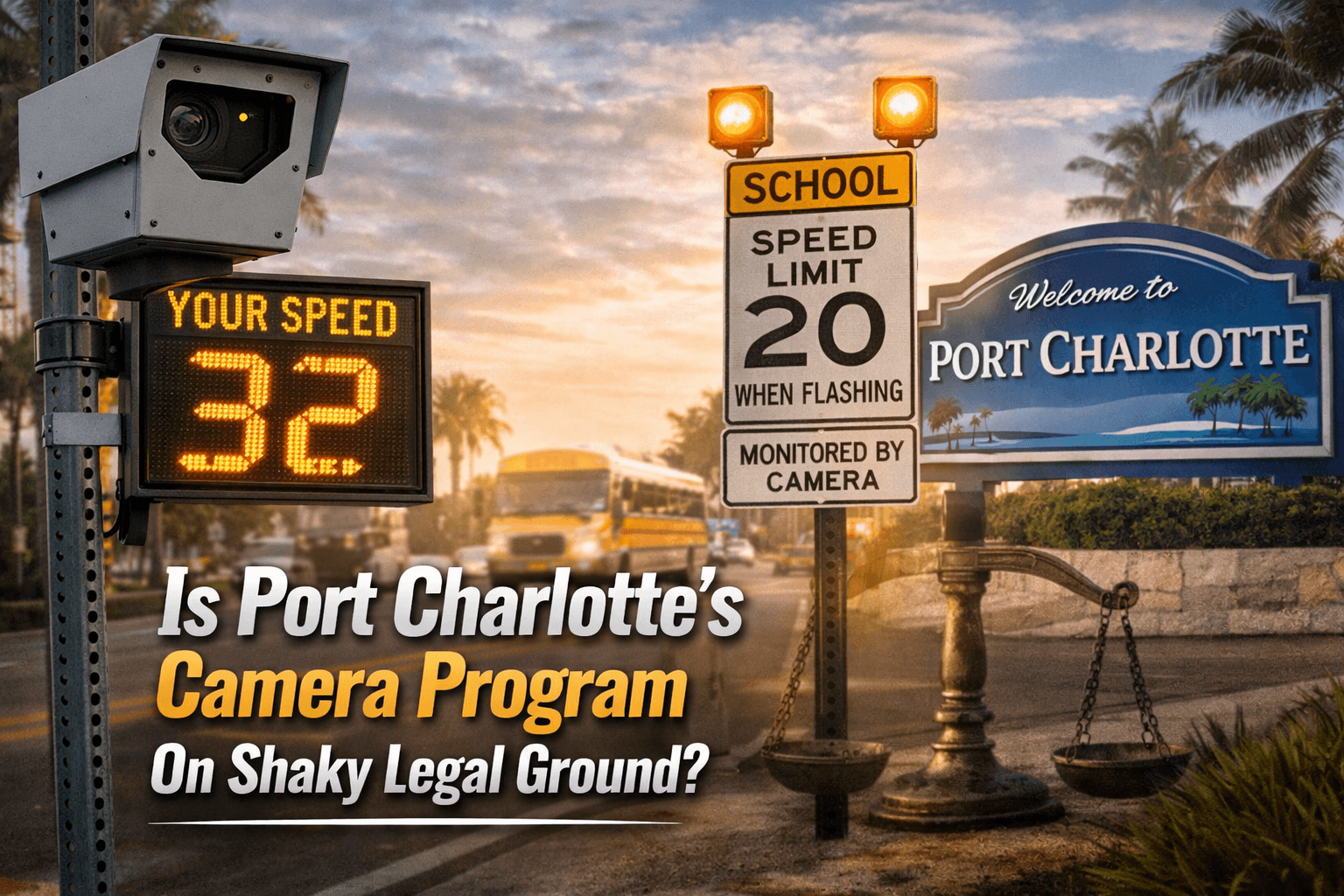
For now, it’s just one ruling. One case.But legal shifts rarely stay contained. Because Charlotte County has already launched its School Zone Camera Safety Program, and that rollout includes schools in the Port Charlotte area. County documents specifically identify Port Charlotte High School and Port Charlotte Middle School among the locations in the program’s early phases.
School zone cameras. Cameras watching. Systems recording. Citations issued when a vehicle exceeds the speed limit during designated times. And just like red-light cameras, those tickets go to the registered owner of the vehicle, not necessarily the driver. That’s where the connection becomes impossible to ignore. It also raises a more uncomfortable possibility—one that hasn’t been widely discussed yet.
Port Charlotte may now be part of a program that could prove to be constitutionally indefensible before it even fully settles in.
If the same legal logic applied in Broward holds up in higher courts, then the very foundation of automated ticketing—assigning liability to a vehicle owner without proving who was driving—could be on shaky ground from the start.
That’s because appellate courts don’t just decide individual cases—they interpret the Constitution in a way that applies across similar laws statewide. If a higher court agrees that shifting the burden of proof to a vehicle owner violates due process, that ruling wouldn’t be limited to red-light cameras alone. It would apply to any enforcement system built on the same legal mechanism, regardless of the type of infraction.
In other words, if the problem is the method of enforcement, not the specific violation, then school zone cameras and other automated systems that rely on identifying a vehicle—but not a driver—could fall under the same constitutional scrutiny.
And the legal world is already reacting. Firms like The Ticket Clinic have been spotlighting school-zone camera enforcement, while news coverage following the Broward ruling indicates that challenges to automated citations are gaining more attention statewide.
That kind of response doesn’t happen in a vacuum. It signals that people are paying attention—and more importantly, that attorneys see opportunity.
Florida’s school-zone camera programs are currently authorized under section 316.1896, with related local enforcement authority addressed in section 316.008 and signage requirements in section 316.0776. The Florida Department of Transportation also maintains guidance for school-zone speed detection systems.
If this Broward case moves forward—and most expect it will—it won’t just be about one red-light ticket anymore. It will be about a principle. A legal standard. A question that could ripple outward across Florida: Can automated systems assign penalties without proving who was actually behind the wheel?
If higher courts say no, the implications don’t stop at intersections. They extend to school zones, to speed enforcement, and to any system built on that same assumption.
For now, life in Port Charlotte continues as usual. The cameras are active or scheduled for activation.Warning periods have already begun in Charlotte County. Citations are part of the county’s enforcement rollout. But something has shifted beneath the surface.
Because once a legal argument like this gains traction—once it starts moving through appellate courts—it stops being about one case and starts becoming about precedent. And precedent has a way of traveling. If the case is appealed, it could climb into the appellate system and potentially shape how similar automated enforcement laws are interpreted across Florida.
And if those courts agree with the reasoning—that due process requires proof of who was actually driving—then the entire structure of automated enforcement could be forced to change. Or unravel. That’s not a certainty. But it’s no longer out of the question.
Even the rollout itself shows how much local government is already investing in these systems. Charlotte County says its 30-day warning period began February 27, 2026, with citations beginning after that, and county presentations show this program has been actively designed, phased, and prepared for multiple school zones across the community.
This movement is gaining substantial momentum. Constitutional consumer advocate websites like stopthecams.org have gained incredible traction as a result of this issue.
Most people won’t notice this story right away. There’s no flashing camera, no ticket in the mail—at least not connected to this case. Yet. but once these tickets start going out.....
But sometimes the biggest local impacts start somewhere else entirely. A courtroom in another county. A single legal challenge. A question that refuses to go away. And if that question keeps moving forward…
Port Charlotte may eventually find itself answering it too. |
0 Comments
Join the conversation
Be the first to comment
Share your thoughts above.